Partial derivatives and the tangent plane
A surface \(z = f(x, y)\) can rise in one direction and fall in another. How do you measure its slope at a point?
Move in one direction at a time. Hold \(y\) fixed and the surface becomes a curve in \(x\); the slope of that curve is the partial derivative \(f_x\). Hold \(x\) fixed instead and you get \(f_y\). Stage 1 asks you to estimate both from a contour map before the page shows the two curves; the later stages build a plane from the two slopes and prove when it fits the surface.
Before you start · 3 quick checks on derivatives, tangent lines and level curves, about 3 min
A function of two variables \(f\) gives a number \(f(x, y)\) for each point \((x, y)\) of a region of the plane. Its graph is the surface \(z = f(x, y)\): above the point \((x, y)\) it has height \(f(x, y)\).
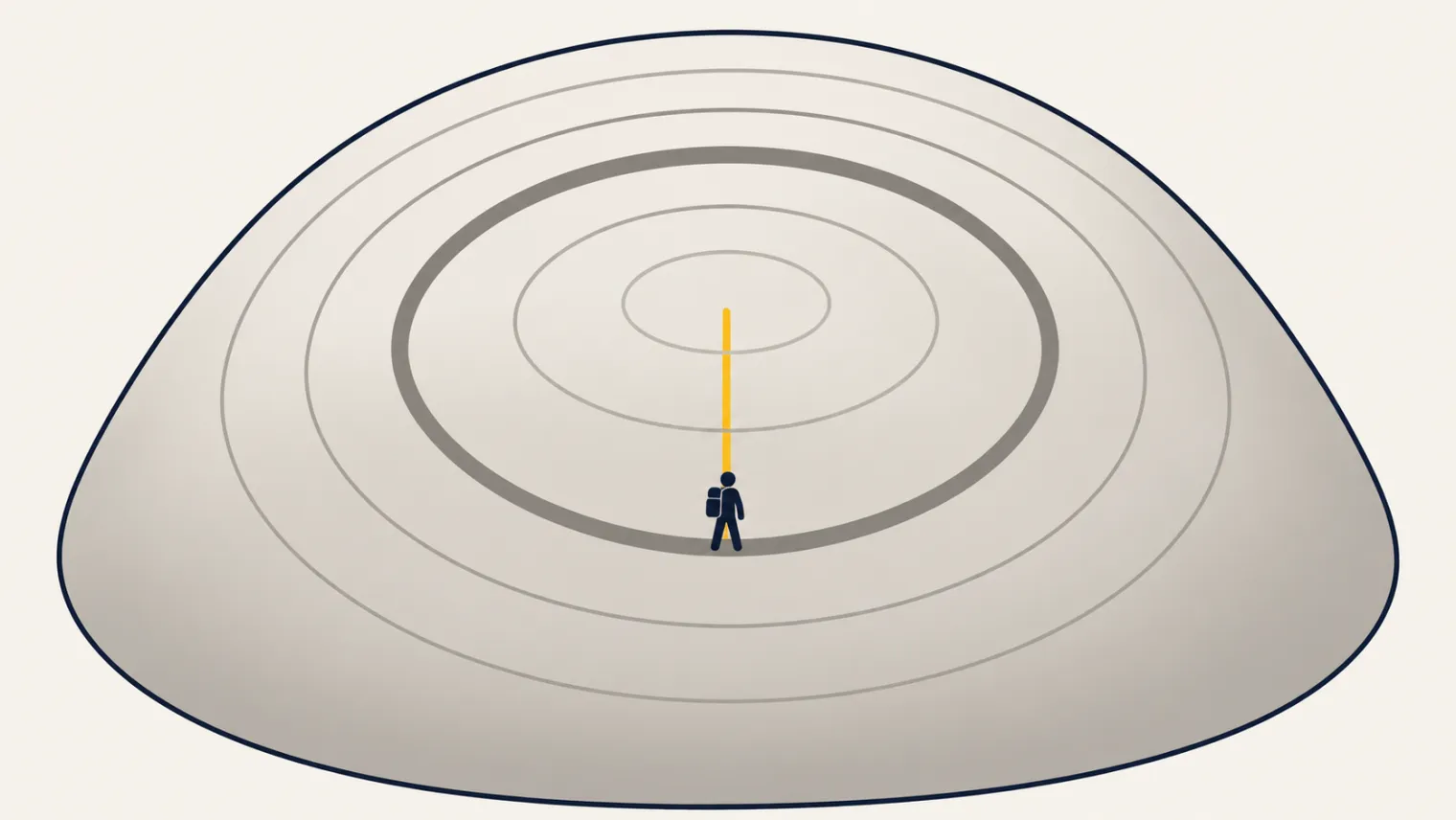
A level curve, or contour, of \(f\) is the set of points where \(f(x, y) = c\) for one number \(c\). A contour map draws level curves for equally spaced heights \(c\), like the height lines on a hiking map: where they crowd together, the surface is steep.
Partial derivatives. Let \((a, b)\) be a point of the region with an open disk around it that also lies in the region. The partial derivatives of \(f\) at \((a, b)\) are
\[ \begin{aligned} &f_x(a, b) \\ &= \lim_{h \to 0} \frac{f(a+h, b) - f(a, b)}{h}, \end{aligned} \] \[ \begin{aligned} &f_y(a, b) \\ &= \lim_{k \to 0} \frac{f(a, b+k) - f(a, b)}{k}, \end{aligned} \]when these limits exist and are real numbers. They are also written \(\partial f/\partial x\) and \(\partial f/\partial y\). So \(f_x(a, b)\) is the ordinary derivative at \(x = a\) of the slice \(x \mapsto f(x, b)\), the curve in which the vertical plane \(y = b\) cuts the graph, and \(f_y(a, b)\) is the derivative at \(y = b\) of the slice \(y \mapsto f(a, y)\). To compute \(f_x\), treat \(y\) as a constant and differentiate in \(x\): for \(f(x, y) = x^3y^2\), \(f_x = 3x^2y^2\) and \(f_y = 2x^3y\).
The plane of the two slopes. When \(f_x(a, b)\) and \(f_y(a, b)\) exist, the plane
\[ \begin{aligned} z = f(a, b) &+ f_x(a, b)(x - a) \\ &+ f_y(a, b)(y - b) \end{aligned} \]passes through the point \((a, b, f(a, b))\) of the graph, and its slices \(y = b\) and \(x = a\) are the tangent lines of the two slices of the graph. When \(f\) is differentiable at \((a, b)\), a condition defined in stage 3, this plane is called the tangent plane at \((a, b)\). Every function in stages 1 and 2 is a polynomial, and stage 3 shows that polynomials are differentiable at every point.
Reading slopes on a contour map
Suppose the contours are drawn every 0.5 in height, and move to the right near a point \(P\). Between two neighboring contours that you cross one after the other, a horizontal distance \(d\) apart, the slice changes by exactly 0.5 in height, so its average slope over that stretch is \(0.5/d\) when the heights increase and \(-0.5/d\) when they decrease. For a function with continuous partial derivatives, the mean value theorem makes the average slope over a short stretch close to \(P\) close to \(f_x(P)\), so the spacing \(d\) of the contours next to \(P\) gives \(|f_x(P)| \approx 0.5/d\). Moving up instead of right gives \(f_y(P)\) in the same way.
The slice figures in stage 1 use the same scale on both axes, so a slope of 1 is drawn at 45° and every slope you see is the true one.
Estimate two slopes from a contour map
Each goal shows a contour map of a function \(f\) on a square and marks a point \(P\) with a cross. A more strongly shaded band is higher. Estimate \(f_x(P)\), the slope as you move right from \(P\), and \(f_y(P)\), the slope as you move up, with the two sliders, then press Check my slopes. The page then cuts the graph along the two lines through \(P\) and draws both slices with your slopes and the true ones.
How the estimates are scored
How close is the tangent plane?
A prediction first; the explorer opens when you have answered it.
The explorer opens when you have answered the question above.
Explorer: steps away from P
Continuous partial derivatives give a tangent plane
Let \(f\) be defined on an open disk around \(P = (a, b)\), and write \(r = \sqrt{h^2 + k^2}\) for the length of a step \((h, k)\). The function \(f\) is differentiable at \(P\) when there are numbers \(m\) and \(n\) such that the error
\[ \begin{aligned} e(h, k) &= f(a+h, b+k) \\ &\quad - f(a, b) - mh - nk \end{aligned} \]satisfies \(e(h, k)/r \to 0\) as \((h, k) \to (0, 0)\). Then \(m = f_x(a, b)\) and \(n = f_y(a, b)\): take \(k = 0\), so \(r = |h|\), and the condition gives \(\big(f(a+h, b) - f(a, b)\big)/h\) \(- m \to 0\). The plane \(z = f(a, b) + m(x - a)\) \(+ n(y - b)\) is then the tangent plane, and the error of the plane is small even compared with the length of the step.
Let \(f\) be defined on an open disk of radius \(\rho \gt 0\) around \(P = (a, b)\). Suppose \(f_x\) and \(f_y\) exist at every point of this disk and are continuous at \(P\). For a step \((h, k) \ne (0, 0)\) with \(r = \sqrt{h^2 + k^2} \lt \rho\), let
\[ \begin{aligned} E(h, k) &= f(a+h, b+k) \\ &\quad - f(a, b) - f_x(a, b)h \\ &\quad - f_y(a, b)k, \end{aligned} \]the error of the plane of the two slopes above the point \((a+h, b+k)\). Then
\[ \frac{E(h, k)}{r} \to 0 \]as \((h, k) \to (0, 0)\), so \(f\) is differentiable at \(P\). In particular, a polynomial in \(x\) and \(y\) has polynomial partial derivatives, which are continuous, so it is differentiable at every point.
Facts the proof uses. The mean value theorem for a function of one variable; a function with a derivative at a point is continuous there; the triangle inequality; and \(|h| \le r\), \(|k| \le r\).
Build the proof one line at a time; each line has one correct choice. A wrong option is a false claim: either a claim about all steps \((h, k)\), or a rule stated for a whole class of functions (every such \(f\), with partial derivatives on the disk that are continuous at \(P\), or a wider class), which some function in that class breaks.
What does not follow
Let \(g(x, y) = \dfrac{xy}{x^2 + y^2}\) for \((x, y) \ne (0, 0)\) and \(g(0, 0) = 0\). On both axes \(g = 0\), so \(g_x(0, 0) = g_y(0, 0) = 0\), and away from \((0, 0)\) both partial derivatives exist by the usual rules. But \(g(t, t) = \tfrac12\) for every \(t \ne 0\): arbitrarily close to the origin the graph is at height \(\tfrac12\), so \(g\) is not even continuous at \((0, 0)\), and no plane fits it there. The theorem does not apply, because \(g_x\) is not continuous at \((0, 0)\): \(g_x(0, t) = 1/t\) for \(t \ne 0\).
In the Black–Scholes model, hold a European call's strike, volatility and interest rate fixed. Its price \(V(t, S)\) then depends on the time \(t\) and the stock price \(S\), and before expiry, for \(t \lt T\) and \(S \gt 0\), it has continuous partial derivatives. Two of them, \(\Theta = \partial V/\partial t\) and \(\Delta = \partial V/\partial S\), are among the Greeks, and the tangent plane at such a point gives the first-order estimate \(\Delta V \approx \Theta\,\Delta t + \Delta\,\Delta S\) for small moves. The Greeks lesson adds the second-order term in \(S\) that this plane leaves out.
Problems
Each problem has hints and a full solution. Exact answers are graded exactly: type whole numbers, exact decimals such as 0.5 or fractions such as 1/2, and separate the numbers with a comma where a problem asks for two. Where an answer is rounded (P4), the accepted error is stated.
Related: Why the chain rule multiplies, for functions of one variable, and The Greeks, where the partial derivatives of an option price get their names.
Further reading
- J. Stewart, Calculus: Early Transcendentals, 8th ed. (Cengage, 2016), sections 14.1, “Functions of Several Variables,” 14.3, “Partial Derivatives,” and 14.4, “Tangent Planes and Linear Approximations.”
- J. E. Marsden and A. Tromba, Vector Calculus, 6th ed. (W. H. Freeman, 2012), chapter 2, “Differentiation,” for differentiability and continuous partial derivatives.
- M. Spivak, Calculus on Manifolds (W. A. Benjamin, 1965), chapter 2, “Differentiation,” on partial derivatives and the derivative of a function of several variables.