Convergent sequences and the ε–N game
What does it mean for a sequence of numbers to converge to a limit L?
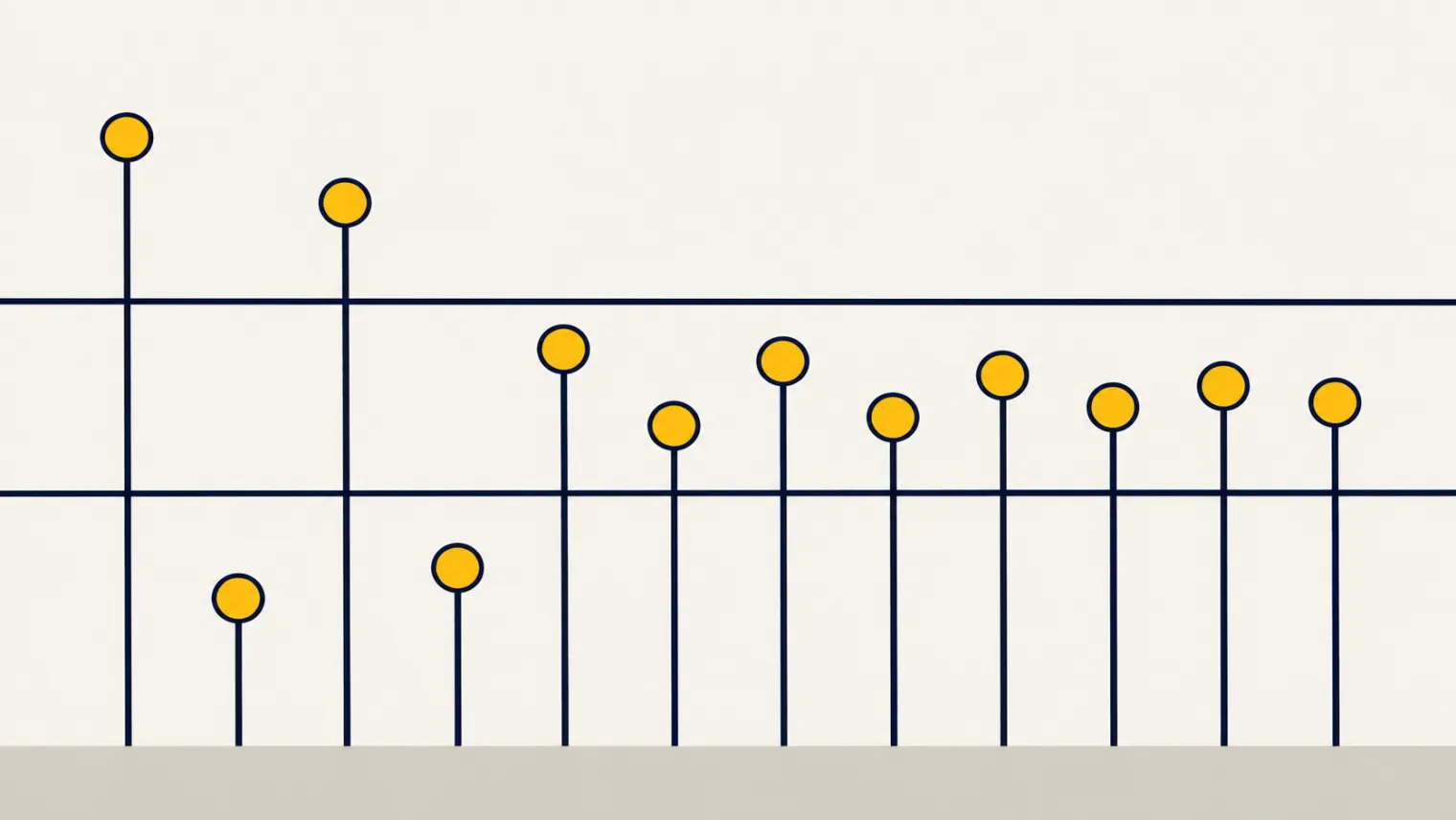
Someone names a band of half-height ε around L. You answer with an index N such that every term from the N-th on lies inside the band. The sequence converges to L when you can answer every ε > 0, however small.
Before you start · 3 quick checks on absolute value, strict inequalities and the order of “for every” and “there is”, about 3 min
A sequence is a list of real numbers \(a_1, a_2, a_3, \ldots\), one term \(a_n\) for each whole number \(n \ge 1\). Formally it is a function from the whole numbers \(1, 2, 3, \ldots\) to the real numbers. On this page “whole number” means one of \(1, 2, 3, \ldots\).
Limit of a sequence. The sequence \((a_n)\) converges to the number \(L\), written \(a_n \to L\) or \(\lim_{n \to \infty} a_n = L\), when for every \(\varepsilon \gt 0\) there is a whole number \(N\) such that
\[ |a_n - L| \lt \varepsilon \quad \text{for every } n \ge N. \]\(|a_n - L| \lt \varepsilon\) means \(L - \varepsilon \lt a_n \lt L + \varepsilon\): the term lies in the band of half-height \(\varepsilon\) around \(L\). A term with \(|a_n - L| = \varepsilon\) sits on the edge and is not in the band. A sequence that converges to some number is convergent; one that converges to no number is divergent.
The Archimedean property. For every real number \(x\) there is a whole number \(N\) with \(N \gt x\): the whole numbers have no upper bound.
Fine print: what N may depend on, and what does not matter
\(N\) is chosen after \(\varepsilon\) and may depend on it. It need not be the smallest index that works: if \(N\) works, so does every larger whole number.
Only the tail matters: changing finitely many terms changes neither whether the sequence converges nor its limit. Some sequences start at \(n = 0\) or at another index; the definition is the same.
The lesson on why the real numbers can't be listed uses lists \(a_1, a_2, a_3, \ldots\) of this kind and shows that no sequence contains every real number.
Defend the limit: answer ε with N
In each goal the page names a sequence, a claimed limit \(L\) and a band half-height \(\varepsilon\). You type a whole number \(N\) and press Defend. The page then checks the terms \(a_N, a_{N+1}, \ldots\) and shows the first one outside the band, if there is one. If you think no \(N\) can work, press No N works.
How the page checks every term from N on
Switch sides: you name ε
Two questions first. The challenge below opens when you have answered both.
The challenge opens when you have answered the two questions above.
Now the page defends and you attack. In each goal the page claims a limit. You name a band half-height \(\varepsilon\); the page answers with the smallest \(N\) that defends the band, worked out exactly, or admits that no \(N\) does. Type \(\varepsilon\) as a decimal such as 0.002 or a fraction such as 1/500.
A first ε–N proof
Let \(a_n = \dfrac{n^2 + n}{2n^2 + 1}\) for whole numbers \(n \ge 1\). Then \(a_n \to \tfrac12\): for every \(\varepsilon \gt 0\) there is a whole number \(N\) such that \(|a_n - \tfrac12| \lt \varepsilon\) for every \(n \ge N\).
Facts the proof uses.
- the Archimedean property from the setup;
- for positive numbers, a smaller numerator or a larger denominator gives a smaller fraction: if \(0 \lt p \le p'\) and \(q \ge q' \gt 0\), then \(\tfrac{p}{q} \le \tfrac{p'}{q'}\), with strict inequality when \(p \lt p'\) or \(q \gt q'\).
Build the proof one line at a time; each line has one correct choice. Each option is a statement about the \(\varepsilon\), \(N\) and \(n\) of the proof. A wrong option is false in every case it speaks of, or claims a rule that fails.
What follows
Suppose \(a_n \to L\) and \(a_n \to M\) with \(L \ne M\). Take \(\varepsilon = \tfrac{|L - M|}{2}\), which is positive. There is \(N_1\) with \(|a_n - L| \lt \varepsilon\) for every \(n \ge N_1\), and \(N_2\) with \(|a_n - M| \lt \varepsilon\) for every \(n \ge N_2\). For \(n = \max(N_1, N_2)\) both hold, and the triangle inequality gives
\[ \begin{aligned} |L - M| &\le |L - a_n| + |a_n - M| \\ &\lt \varepsilon + \varepsilon = |L - M|, \end{aligned} \]which is impossible. So \(L = M\).
Suppose \(b_n \le a_n \le c_n\) for every \(n \ge N_0\), and \(b_n \to L\) and \(c_n \to L\). Then \(a_n \to L\).
Proof. Let \(\varepsilon \gt 0\). There is \(N_1\) with \(L - \varepsilon \lt b_n\) for every \(n \ge N_1\), and \(N_2\) with \(c_n \lt L + \varepsilon\) for every \(n \ge N_2\). For every \(n \ge N = \max(N_0, N_1, N_2)\), \(L - \varepsilon \lt b_n \le a_n \le c_n \lt L + \varepsilon\), so \(|a_n - L| \lt \varepsilon\).
For example, \(-\tfrac{1}{n} \le \tfrac{\sin n}{n} \le \tfrac{1}{n}\) for every \(n \ge 1\) (with \(n\) in radians), and both bounds tend to 0, so \(\tfrac{\sin n}{n} \to 0\).
The ε–δ definition of a limit plays the same game for a function: a window \(0 \lt |x - a| \lt \delta\) takes the place of the tail \(n \ge N\). The two are linked: for \(f: D \to \mathbb{R}\) and a limit point \(a\) of \(D\), \(f(x) \to L\) as \(x \to a\) exactly when \(f(x_n) \to L\) for every sequence \((x_n)\) in \(D\) with \(x_n \ne a\) and \(x_n \to a\).
The lesson on where e comes from uses the monotone convergence theorem: an increasing sequence whose terms stay below a fixed number converges. Its proof needs the completeness of the real numbers (every nonempty set of real numbers with an upper bound has a least upper bound), which the ε–N definition alone does not give.
Problems
Each problem has hints and a full solution. Answers that ask for \(N\) are whole numbers and are graded exactly; type digits only.
Next: The ε–δ definition of a limit. Related: Where e comes from and Why the real numbers can't be listed.
Further reading
- S. Abbott, Understanding Analysis, 2nd ed. (Springer, 2015), section 2.2 (The Limit of a Sequence) and section 2.3 (The Algebraic and Order Limit Theorems).
- R. G. Bartle and D. R. Sherbert, Introduction to Real Analysis, 4th ed. (Wiley, 2011), sections 3.1 and 3.2 (Sequences and Their Limits; Limit Theorems).
- M. Spivak, Calculus, 4th ed. (Publish or Perish, 2008), chapter 22 (Infinite Sequences).